GENERAL NEWS / 01-04-2026
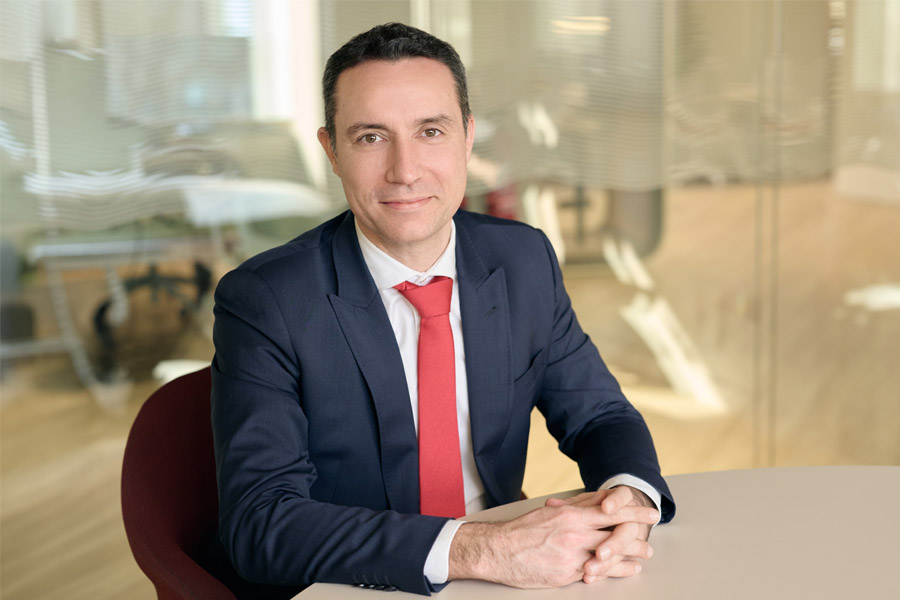
Interview with José Manuel Lucio. Managing director of AR Racking
“It is only with committed, highly trained staff that we have been able to reach these levels of development and innovation”
José Manuel Lucio is not daunted by the turbulent geopolitical times the world is experiencing as he makes his business forecast: “Our perspectives for the future are to keep growing”. His statement is based on two axes: on one hand, the existence of markets with enormous potential for growth where AR Racking can expand and, on the other, the company's powerful innovative muscle. Nevertheless, the root of this confidence lies with something that has come up on several occasions: the human factor. Although he is aware of the changes caused by the cultural and generational transformation in the way companies operate, the Managing Director of AR Racking is committed to building a business model that will be attractive to new generations, able to retain talent and maintain the levels of development and innovation that ensure competitiveness.
Question. In recent years AR Racking's growth has been exponential, from both business and labour perspectives. What were the key factors for this growth?
Answer. Basically, there have been two key factors: the first, the geographic expansion, the development of new markets. We're gradually increasing the number of markets in which we're present, and this includes Europe and more and more countries in North and South America. We have subsidiaries in Chile, Colombia and Peru, and in the United States and Canada, and distributors in many countries on the American continents. The second axis is based on innovation and the ability to develop new solutions, which are ultimately also the key to opening up new markets, closely linked to automated, integration and robotics solutions. We are advancing at the pace required by innovation and robotics, and thanks to that innovation we are gaining new customers and developing solutions that make it possible to open up new business.
Q. What is striking about this growth is that it has happened despite the international unrest. How have you managed to overcome the situation?
A. In some of these crises, such as COVID, logistics continued to operate, in other words, people still needed goods and services, and factories and warehouses that supply them. Moreover, some of these economic shocks caused changes in the supply chain that required investment in our solutions. Another very important reason is the innovation and modernisation of installations. Ten years ago warehouses were fairly conventional and forklift-operated, now there some who choose to remove that slower, manual installation, that needs more staff, and replace it with a robotised system. That transformation increases our capacity for shelving installations.
“Wherever we see a market we aim for growth. What we try to do is select the markets or solutions that are the most favourable for our expansion in terms of staffing and economic resources”.
Q. Even in more difficult times, have you always been sure of your aim for growth?
A. Wherever we see a market we aim for growth. What we try to do is select the markets or solutions that are the most favourable for our expansion and do so to the extent possible in terms of our staffing and economic resources. The topic of people is very important because this is a business that's very much based on engineering, and so we need to develop a powerful, robust human team of engineers to provide products with the highest standards of safety. And this requires highly trained, specialised staff.
Q. We are currently in a situation, almost unprecedented in recent times, of open war in the Middle East. How is it affecting AR Racking's business?
A. Today, on the sales and commercial side, we have a very limited presence in the region, so the effects are minimal. Where it can affect us more is in all things related to the supply of raw materials from some Asian manufacturers. In the end, what this conflict is going to generate is tension in the supply chain, extended timelines and increased transport costs. Right now, in the short term, what could affect us most is the supply chain from Asia to Europe, the cost of these shipments and the delivery times..
“In the international context the world is going to swing towards more local supplies of raw materials, and in the medium term this is going to bring purchasing towards European steelworks”.
Q. Is there a plan B?
A. Yes, our plan B in principle is for these ships to go around Africa and that in this international context of trade wars the world is going to swing towards more local supplies of raw materials. There are already tariffs on imports of raw materials from Asia, import fees, etc. and in the medium term this is going to bring purchasing towards European steelworks.
“We have opportunities for growth in North America, because we're still very small in that market, and other more limited options in Europe, Central America and South America”.
Q. And despite this situation, are you aiming for growth?
A. Yes, we believe that despite the highly turbulent situation we still have opportunities in North America because we're still very small in the American market, so I believe we'll have options for growth and other more limited options for development in Europe and in Central America and South America.
“The investment by the Government of Navarre in the Tudela plant is an honour and a very important sign of trust in our business projects and our commitment to this region”.
Q. On a more local scale, what is the context for the €8M investment by the Government of Navarre through the INI for Tudela plant?
A. The investment by the Government of Navarre is an honour. Grupo Arania originated in the Basque Country but has a business unit in Navarre and we're very fond of the factory and its workforce. That after 20 years of activity in Navarre the Regional Government has decided to invest in us is a very important sign of trust and I believe it's a message that AR Racking is committed to Navarre and that the government supports business projects that contribute to developing the region. As a story, it's very nice, and on the economic side it seems to me that they're a very important partner for us because they provide significant economic support and give the business project a robust image with the public institutions and bodies.
“Our processes are highly automated; our plant is likely one of the most modern in Europe and enables us to work with very high product quality standards”.
Q. From the point of view of internal processes, what would you say are your competitive advantages?
A. On the production side we have highly automated processes, probably one of the most modern plants in Europe. And this allows us to work with very high product quality standards. On the other is a very important human team based on innovation and engineering, because in the end we're a market that prioritises safety. Customers place their trust in us so that many people can work around our shelves and we want to offer robustness in both engineering and safety. To be that reliable partner our customers need, we have very good capacity for product development and to adapt the engineering to the solutions the customer needs.
“We have to be able to generate a business project that inspires people who have been around for 10 or 20 years just as much as those who are new because they're the basis for our future”.
Q. That human team, is that one of the pillars on which your innovation policy is based?
A. Yes, in the end it's the people that make the company. All the Grupo Arania companies put people first, but in the case of a business with such a strong engineering component as ours it's essential. It's only by having engineering professionals with very high technical abilities, with a personal commitment and a personal development project with significant skills that we can reach these levels of development in innovation, new products and correctly fulfilling projects on time. We live a world in which we're going to compete for talent, where it's essential that the teams are committed, where we also have to undergo a cultural and generational transformation, and assimilate these changes naturally, as previous generations did with us. We have to be able to generate a business project that inspires people who have been around for 10 or 20 years just as much as those who are new, so that they stay for many years, because they are the basis for our future.
“We're working on mechanisms to reduce our carbon footprint and collaborate with steelworks to bring to the market products that gradually reduce emissions”.
Q. A commitment to sustainability is another of the Group's strategic commitments. Have you got a roadmap towards that dream goal of zero emissions?
A. We have already measured our carbon footprint, and what we generate in the finished product is very low because the majority of this impact is in the raw material itself. I'm mentioning this because there are two axes: one is where I have a larger radius of action, in other words, what I do in my processes and in my factories, and the other comes from the steel. In the first, we have planned and launched initiatives such as the installation of solar panels that can provide up to 30% of our electricity consumption; we're also investing in energy recovery in our paint furnaces, and within the Group we have commissioned an electric lorry to minimise CO2 emissions. And then there's the steel, which is where the majority of the carbon footprint comes from. Although it's the steelworks that have to do the fundamental part of that work, we have to act as catalysts for that transformation. We have signed an agreement with one of the main European steelworks to buy “green” steel as soon as it becomes available. What we're doing is working on the mechanisms we have today to reduce the carbon footprint and offer it to our customers. Collaborating with steelworks to gradually bring these products that reduce emissions onto the market.
“We have the capacity to keep growing in the coming years and to do so at a double-digit pace”.
Q. What are AR Racking's perspectives for the future?
A. Our perspectives for the future are to keep growing. We have some markets that are mature, such as those closest to us, but there are other very large markets where we still have a lot of growth potential. We also have solutions that are still in development. In the world of intralogistics and automation there are constant innovations that generate business opportunities if we're able to adapt our products to the pace and expectations of robotics and logistics systems suppliers. We have the capacity to keep growing in the coming years and to do so at a double-digit pace.
