We are now big enough to compete, and we are currently in the process of reviewing our model to make it more efficient.
Alberto Lejarreta
Executive Vice-President de Grupo Arania.
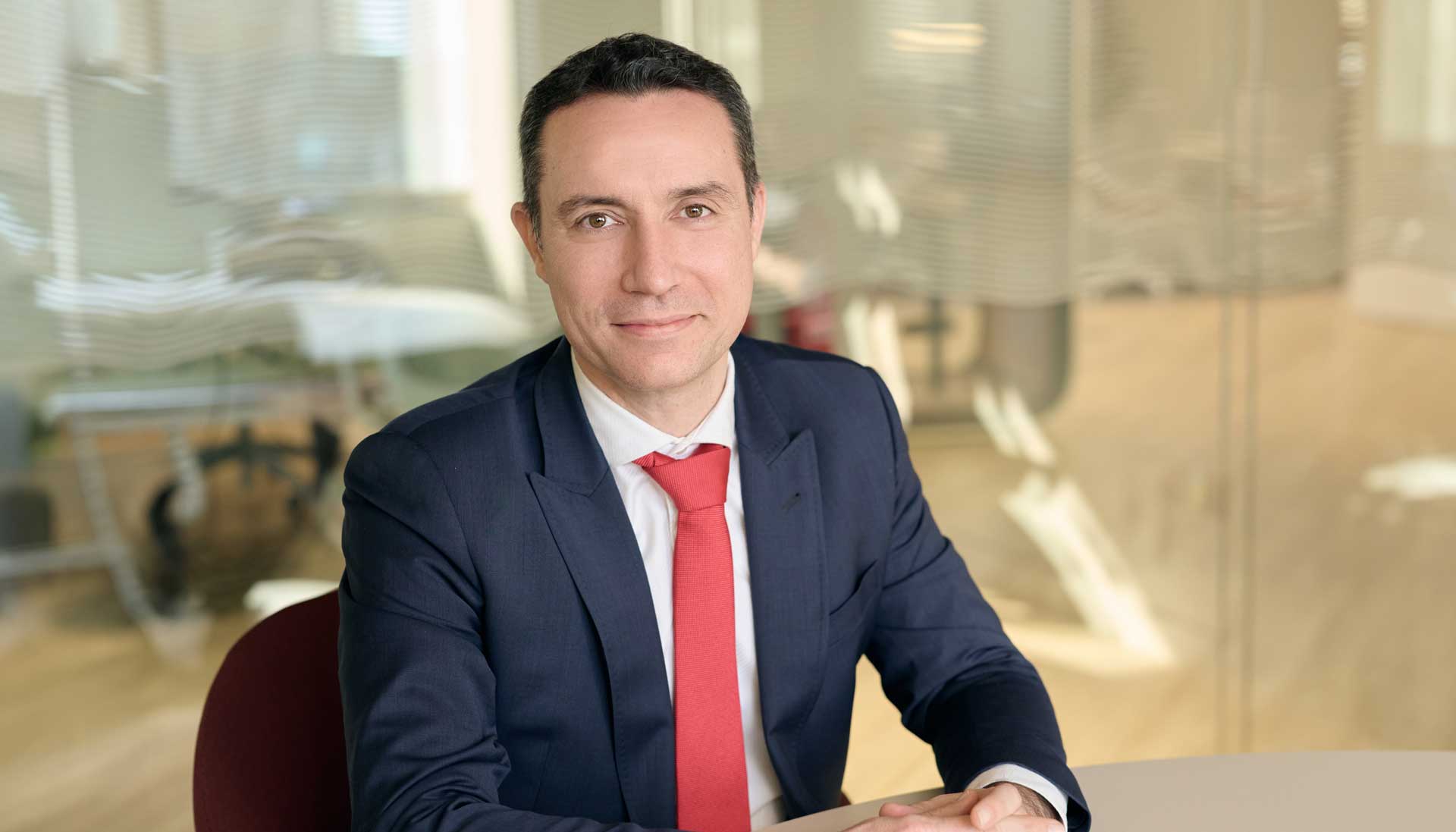
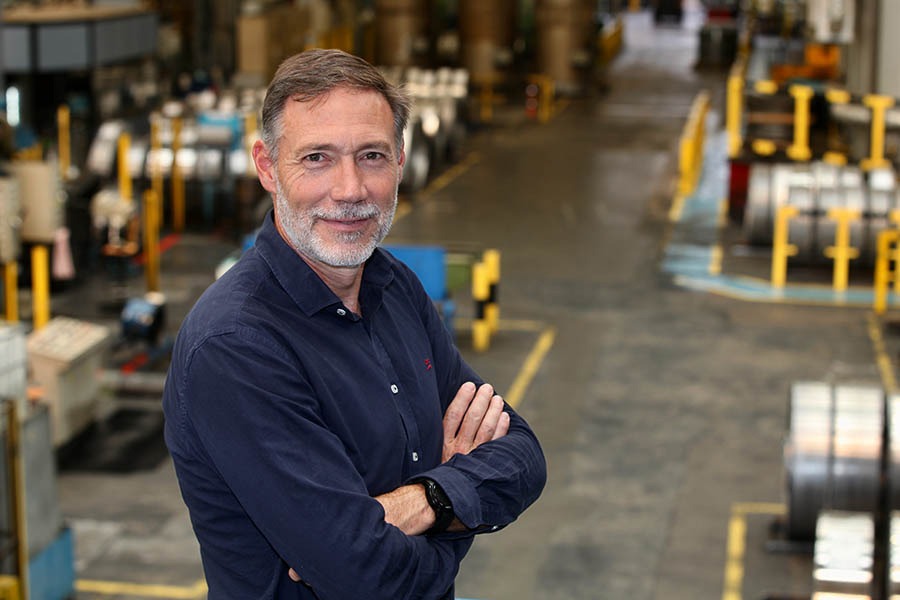
Alberto Lejarreta took over from Carmelo Bilbao as the Executive Vice-President of Grupo Arania approximately one year ago. His assessment of the situation is clear: the Group is the right size to compete in the steel sector in today’s highly competitive market. What the Group needs to do now is complete a reflection process that will enable it to consolidate the model in order to become increasingly efficient. The scenario is complex: a ‘totally disruptive’ US administration that has broken the rules of the market; Asian competitors that are making increasingly innovative products; and a world and market that are changing at breakneck speed. To meet these challenges, Alberto Lejarreta draws on the talent and strength of the more than 1,000 people who are part of the Group, and the four business lines within the Group that complement each other to balance results and offer growth options.
Question. You’ve just taken on the role of Executive Vice-President of Grupo Arania. What legacy did you inherit from Carmelo Bilbao?
Answer. Twenty years of work that have revolutionised what the group used to be. The legacy left by Carmelo Bilbao after 20 years is that of an industrial group that is the right size to compete in the steel industry and in today’s highly competitive international market. A modern, service-oriented group focused on added value and strongly committed to its international vocation. But the most important thing that Carmelo left behind to continue competing is a team of more than 1,000 people who are committed to the project. Talented, enthusiastic people with the strength to compete in this highly complex market.
We have a strong team and solid management that allow us to adapt quickly to changing situations, maintaining the speed we need to stay competitive.
Q. Your appointment comes at a time when the geopolitical situation is complicated, to say the least. Are you concerned about this situation?
A. In the last five years, we’ve had the pandemic; a subsequent chain crisis in which there was a shortage of everything; the war in Ukraine… And just when things seemed to be getting back to normal, the United States held elections, and Donald Trump burst onto the scene in a completely disruptive way, breaking with established rules of international trade and upsetting the existing balance. So, this is the new normal we’re dealing with: constant changes in the global steel market that have a significant impact on business. Am I concerned? To quote the previous vice-president, ‘Don’t worry, Alberto, take action.’ And that’s what we’re doing. Fortunately, we have a great team and excellent management, and the important thing is to be able to adapt to these rapidly changing situations in a timely manner. We’ve also been working very hard on strengthening the foundations of our business. We have strong management teams and talented, well‑prepared people. Over the past few years, we’ve done the groundwork to explore new markets, develop our products, and build a wide range of options and tools that allow us to stay agile and competitive.
Q. What response can the Group offer in this environment?
A. The Group’s balanced size ensures an efficient scale, generating economies of scale and procurement advantages, together with other benefits enjoyed by its four business lines. We have an agile working methodology that lets us pivot quickly and make decisions fast. We’re not one of those massive giants in the sector that struggle to change course. We’re concerned, yes, but we have to accept it for what it is and move very quickly.
We’re neither a small company nor a giant in the sector, but we’re flexible and able to adapt to this changing world at a pace that others may not be able to match.
Q. Another focus of attention in the international context is competition from Asia. What are the Group’s value propositions for addressing this challenge?
A. For years, Asian producers made products that competed on price, but now they’re increasingly making innovative products and changing their value proposition. This is in line with what I mentioned earlier about how quickly the world is changing. That’s why we’re constantly reflecting on what this Group and its four member companies stand for, and how we can offer value to our customers. We have a solid management team, and we take a hard look at each company on a regular basis to determine how they should be competing. It’s not easy, but the Group’s approach is to focus on product development, added value, R&D, and technological development. We now have a corporate AI department that is driving all this within the Group. And then I’d highlight service. Service is people. We have strong, hands‑on relationships with our customers, supported by our own commercial teams and highly skilled technical staff. They know the business inside out, and they’re our eyes in the field, helping us understand how we can truly add value. We’re neither a small company nor a giant in the sector, but we’re flexible and able to adapt to this changing world at a pace that others may not be able to match.
We have decarbonisation plans and are working on multiple aspects in line with what’s happening in the market, but we firmly believe that businesses must be sustainable.
Q. Could one of those elements be the commitment to decarbonisation?
A. The Group has been working on sustainability for several years. Decarbonisation has come into focus in recent times, but our Group has always been committed to both social and environmental aspects. Our Sustainability Department oversees the work of all four business lines in this area, with committees in each one to develop sustainability plans. All Group companies have decarbonisation plans and are working on multiple aspects in line with what’s happening in the market, but we firmly believe that businesses must be sustainable. There are strong plans in place and notable developments, but it’s important to see how all this develops while remaining competitive. I’d also note that this is something that is gaining traction in the markets and society in general. All four business lines are working on projects for customers who are asking us for low-emission steel, which we can already supply. We’re working on projects with some of the major European players such as Salzgitter and Arcelor, and in this regard, I would say that the Group is a leader at a European level.
All four Group business lines transform steel, but they’re all unique; they work in different sectors with different cycles, and this adds diversity to the Group.
Q. The Grupo Arania has four business lines. How do they complement each other in order to maintain efficiency and consolidate growth?
A. The Grupo Arania is an industrial group comprising five member companies sharing a common focus on steel. All five companies transform steel, but they’re all unique. They work in different sectors with different cycles, and this adds diversity to the Group. The four business lines allow us to reach a scale that is well suited to competing in the market. Because we’re able to purchase steel worldwide in large volumes, all five companies benefit from these volumes and synergies. It’s unlikely that all of them line up during an upswing, but it’s also unlikely that they all hit a downturn at the same time. This balance strengthens the Group’s results and creates opportunities for growth across its four distinct business lines. This is one of the Group’s biggest strengths.
Q. These results are the outcome of the work you’ve performed as CEO with Carmelo Bilbao as the Group’s executive vice-president. What would you say have been the pillars of this relationship?
A. Over the last five years, we’ve been focused on promoting the development of added value, opening up markets, managing teams and working hard on the human component, all of which has brought many possibilities for the business. We’ve managed to grow and advance in many areas, and we have many tools at our disposal to compete. But now that we’ve reached our current size, we are in the process of reviewing our model to make it more efficient. We’re now big enough to compete. We’ve evolved significantly. The Group has been working hard in recent years, and now we have the opportunity to continue competing to make our model increasingly efficient, consolidate it, and take a step back to see how we can continue to move forward in the future.
We are at a crucial point in time for orienting our business and determining how to adapt to a new society and a rapidly changing environment.
Q. Where are we now as a Group? What challenges lie ahead?
A. The Group is currently in the process of reflecting on how we can make processes more efficient and consolidate our model. But at the same time, everything is moving at breakneck speed. Donald Trump’s re-election has been tremendously disruptive and has broken all the rules of international trade. We are at a point where we need to see how our four business lines can adapt to this situation, how the economy rebalances itself, and whether a more powerful steel-focused bloc is really being formed in the western part of Europe. The possibility is currently under discussion at a European level to impose restrictions on steel imports, with systems similar to those implemented in the United States… All of this poses a threat to the Group, but it also opens up opportunities. We’re at an impasse, a critical moment, as we wait to see where the economy is heading and how we can continue to move forward, working on the efficiency of our model. It’s a critical moment for us to focus on our businesses and see how we can adapt to this new society and this new situation that is changing at such speed.
We can talk about machines, strategy, automation, and a wide range of other topics, but the Group’s distinguishing factor is undoubtedly its people.
Q. People are the Grupo Arania’s fundamental asset and a pillar of its growth. What do they mean to you?
A. The value of the Group is the value of the people who are part of it. We can talk about machines, strategy, automation, and a wide range of other topics, but a company’s distinguishing factor is undoubtedly its people. The development of our team is certainly a priority for us. We have a very diverse group of people with a variety of skills, and our goal is to create an environment, a working model, and a management style based on trust, where people can let all that talent flow. And at the Group level, how to develop talent within the organisation is a top concern. The reason this group, which has 85 years of history, has managed to come this far is because there have been teams of highly committed, enthusiastic people. That is the key to the Group: the people and the teams that are able to compete in such a complex market.
The best thing about my job is working with people, the human component.
Q. From a more personal point of view, what and whom does Alberto Lejarreta rely on?
A. Of course, this is a team effort and a team sport. I rely on the team, the team relies on me, everyone has their job to do. I’m the executive vice-president and I work with a lot of people every day. The best thing about my job is that I work with people, the human component. In many cases, my responsibilities include providing support and ensuring work is performed effectively, with a sense of enthusiasm and commitment. Sometimes I have to support teams, and other times they have to support me. That’s how it works in this organisation.
It’s important for a manager to be healthy and have the energy to drive things forward. Working with people is wonderful, but it’s also very demanding.
Q. What role do family and sport play in your life?
A. You can’t rely on just one thing to maintain balance. Two other aspects that give me balance are my family and my wife Lierni. We’ve been together all our lives, and she is certainly an important source of balance. I have done sport throughout my entire life. In a position like mine, with such a high level of responsibility and dynamism — involving work across four businesses and a considerable degree of stress — sport is a vital outlet that helps me stay balanced. I seek balance in my colleagues, in my family, and in sport. As the Romans said: ‘Mens sana in corpore sano’ (a healthy mind in a healthy body). It’s important for a manager to be healthy and have the energy to drive things forward. Working with people is very rewarding, but it is also very demanding.